
How take the best photos in paris: the complete guide
Paris has been inspiring photographers for over a century - and for good reason. The city is a rare collision of monumental architecture, narrow romantic streets, golden afternoon light, and a restless, artistic energy that rewards anyone who shows up with a camera and a little patience. But "Paris is beautiful, just point and shoot" is also the fastest way to come home with a memory card full of tourist snapshots that look like everyone else's.
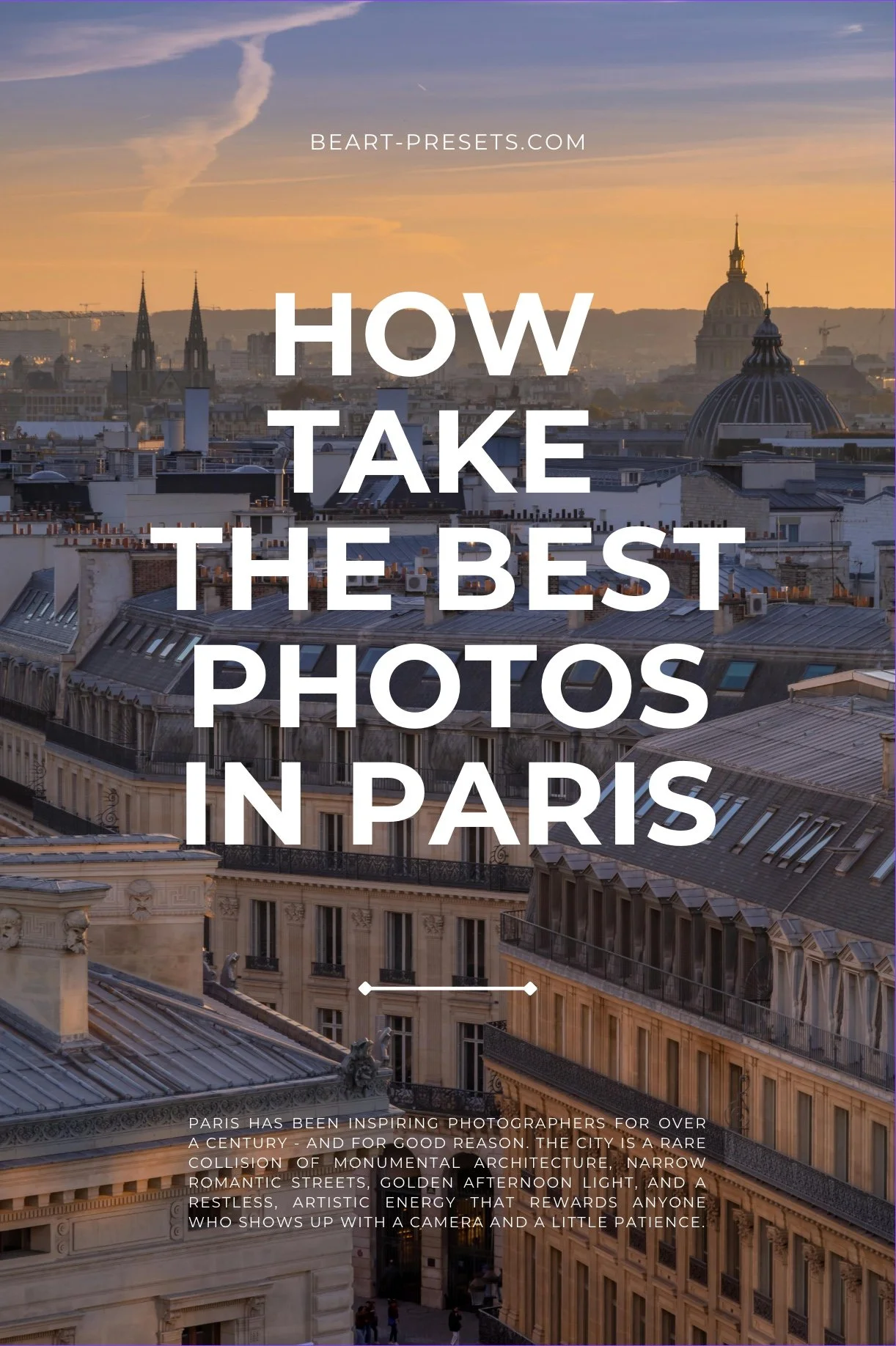
The photographers who actually nail Paris - the ones whose images feel alive, specific, and unmistakably theirs - share a few habits: they shoot at the right time, they know which spots to skip (and which hidden corners to seek out), they understand how the city moves, and they edit with intention. This guide covers all of it.
1. Timing is Everything: When to Shoot in Paris
The single biggest variable in Paris photography isn't your camera body or your lens - it's the light, and light in Paris changes dramatically across the day. Shoot at the wrong time and even the most iconic locations look flat. Shoot at the right time and an ordinary street corner becomes something extraordinary.
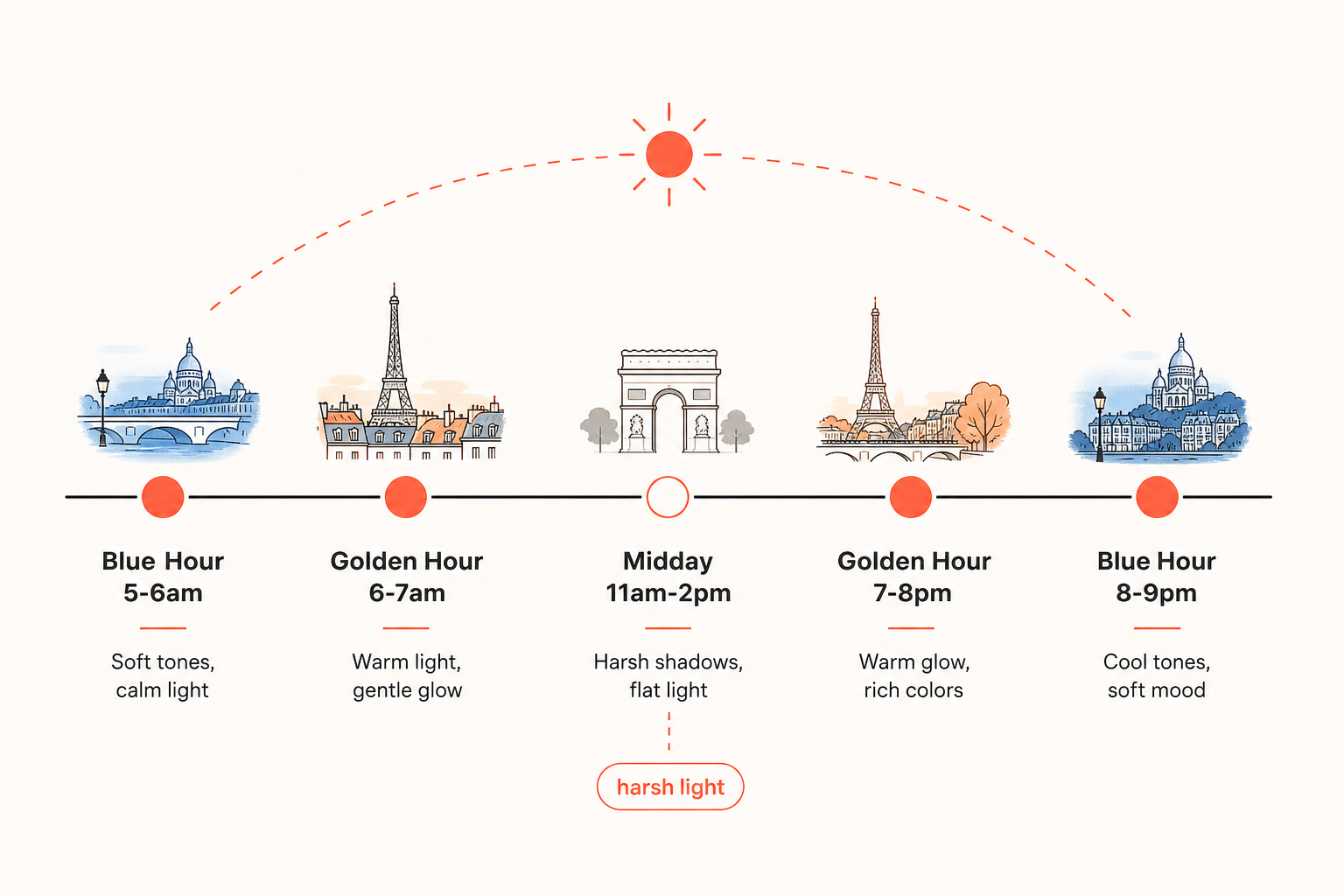
Golden Hour (roughly 6-7am and 7-8pm in summer) is the obvious answer, and it earns that reputation. The low angle of the sun warms the Haussmann limestone to a deep amber, fills in shadows softly, and gives everything a three-dimensional quality you simply can't replicate in post. The evening golden hour is spectacular but crowded at the major landmarks - if you want it to yourself, the morning window is the move.
Blue Hour (the 30-45 minutes just after sunset) is arguably even better for Paris specifically. The city's street lamps, café windows, and monument lights come on while there's still enough ambient light to balance the exposure. The Eiffel Tower's light show starts at dusk. You get a rich, deep sky instead of a black void behind your subject.
Midday (roughly 11am-2pm) is the enemy. The sun is directly overhead, shadows are harsh and unflattering, the stone goes bleached and colorless, and every tourist attraction is at its busiest. Unless you're doing deliberate high-contrast black-and-white work, avoid shooting landmark photos during these hours. Use midday for scouting, eating, editing from the morning session, or shooting in shaded spots like the covered passages.
Overcast days get an unfair reputation. A soft, diffused overcast sky acts like a giant softbox - it's ideal for portraits, street photography, and food shots. It's also often when the Eiffel Tower's reflected surface looks most dramatic against a moody sky. Don't cancel your shoot because of clouds.
Autumn and winter are genuinely underrated. The city is less crowded, the afternoon light is lower and warmer for longer, and the fall foliage in the Tuileries and Luxembourg Gardens adds color the summer heat takes away. Fall and winter in Paris often deliver better photographic value than the peak summer season.
2. The Best Photography Locations in Paris
Everyone knows the Eiffel Tower from Trocadéro. That shot exists, but you'll take it surrounded by hundreds of other people taking the same shot. Paris rewards photographers who look one degree off the obvious.
Iconic Spots - with an Edge
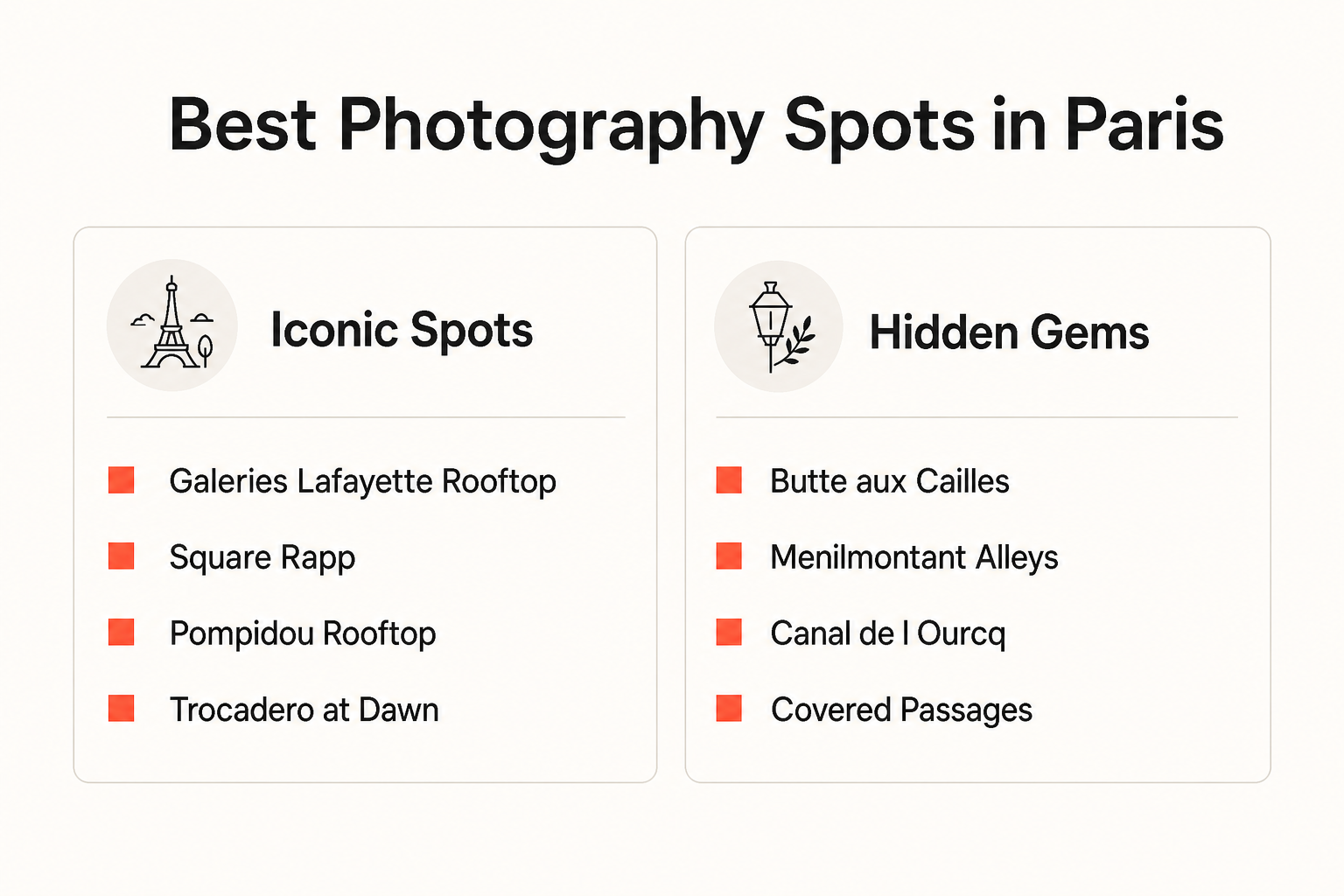
Galeries Lafayette Rooftop is one of Paris's best-kept open secrets. The rooftop terrace is free, open to the public, and sits at an elevated angle that frames the Eiffel Tower with the city's rooftops and Haussmann domes in the foreground. Paris photography regulars on r/ParisTravelGuide call it "the best view of the Eiffel Tower in my opinion" - and it's rarely as busy as Trocadéro.
Square Rapp is a small garden tucked behind the 7th arrondissement, offering a clean, uncluttered Eiffel Tower framing from street level. What makes it genuinely special: it sits adjacent to one of the finest Art Nouveau buildings in Paris, so you can frame the tower through elaborate ironwork and organic stonework for a shot that tells a more interesting story than a straight-on landmark photo. Reddit photographers describe it as "a sneaky good spot" with "bonus points for one of the best Art Nouveau buildings in the city."
The Pompidou Centre Rooftop gives you an elevated panoramic view over the Marais rooftops toward the Seine. You pay a small entry fee just for the rooftop view - no need to go into the museum - and the industrial pipe aesthetic of the Pompidou itself makes for striking architectural foreground elements.
Trocadéro at Dawn is the one time the famous Eiffel Tower shot is worth taking. Get there before 6:30am in summer and you'll often have the esplanade almost entirely to yourself. The light is extraordinary, the fountain reflections (when running) are mirror-perfect, and you're shooting a scene that billions of people know, but almost no one photographs without a crowd.
Hidden Gems Worth the Effort
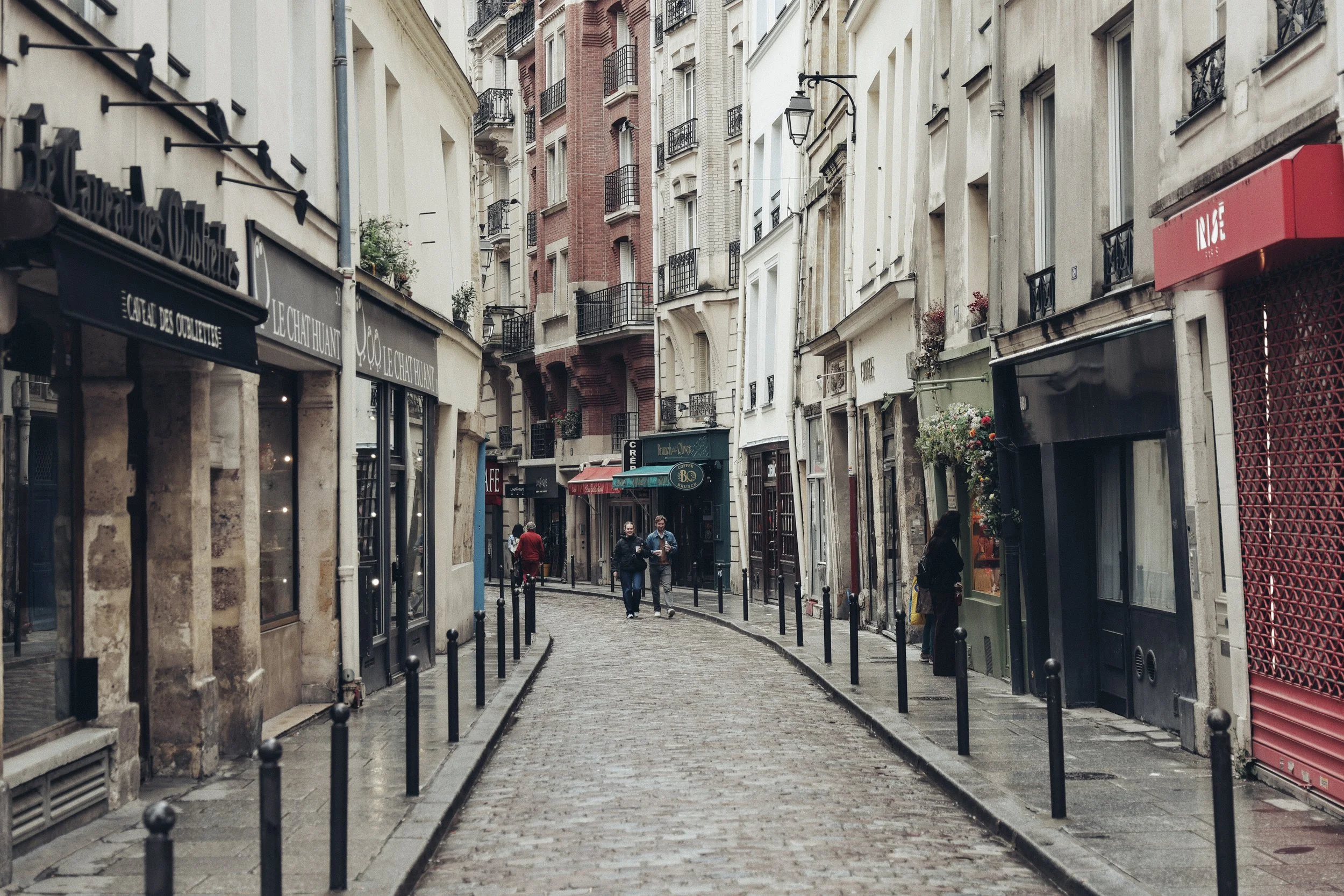
Butte aux Cailles is a hilltop neighborhood in the 13th that looks like it fell through a time warp from a quieter era. Narrow cobblestone streets, low-rise buildings covered in climbing plants, murals around every corner, and a genuinely local atmosphere that reads nothing like a tourist district. Community members describe it as "very 'popular' and typically Parisian" - this is where you find authentic street scenes.
Menilmontant's Hidden Cités - specifically Cité Leroy and Cité de l'Ermitage - are narrow private-feeling alleyways in the 20th that few visitors discover. They have a walled, village-like quality, with window boxes, old wooden doors, and a sense of compressed, layered history. Come in the morning when the light hits the facades directly.
Canal de l'Ourcq is less photographed than Canal Saint-Martin (which has its own charms) and has a rougher, more industrial character that rewards photographers looking for something that doesn't feel polished for Instagram. Reflections, rust, barge culture, and warehouse murals make it a genuinely versatile location.
The Covered Passages - Galerie Vivienne, Passage des Panoramas, Passage Jouffroy - are 19th-century arcades with glass roofs, mosaic floors, and amber light that seems to belong to another century. They're perfect for overcast days when you want atmospheric, architectural street photography. The light quality inside is consistent and often extraordinary, and the human activity (bookshops, coin dealers, tea rooms) adds life to frames that could otherwise feel static.
Meudon Observatory Gardens offers sweeping views of Paris with almost no one around, largely because it takes some effort to reach. As one photographer put it: "beautiful views and very few people - mostly because it's not super easy to access." That friction is a feature.
3. Street Photography in Paris: What You Need to Know
Street photography in Paris is rewarding and demanding in equal measure - and the most important thing to understand before you start is the legal framework.
French law on photography is stricter than many visitors expect. France has significant privacy protections that cover photographing individuals in public - specifically around using or publishing those images without consent. While photographing people in public spaces is generally permitted, distributing or publishing those images commercially or prominently without the subject's consent can create legal exposure. The Paris photography community is consistent on this: "Do some research on photography laws in public - France has some particularly strict laws about taking pictures of people without their consent." If you're planning to publish Paris street photography beyond personal use, research the current regulations carefully or consult a local legal resource.
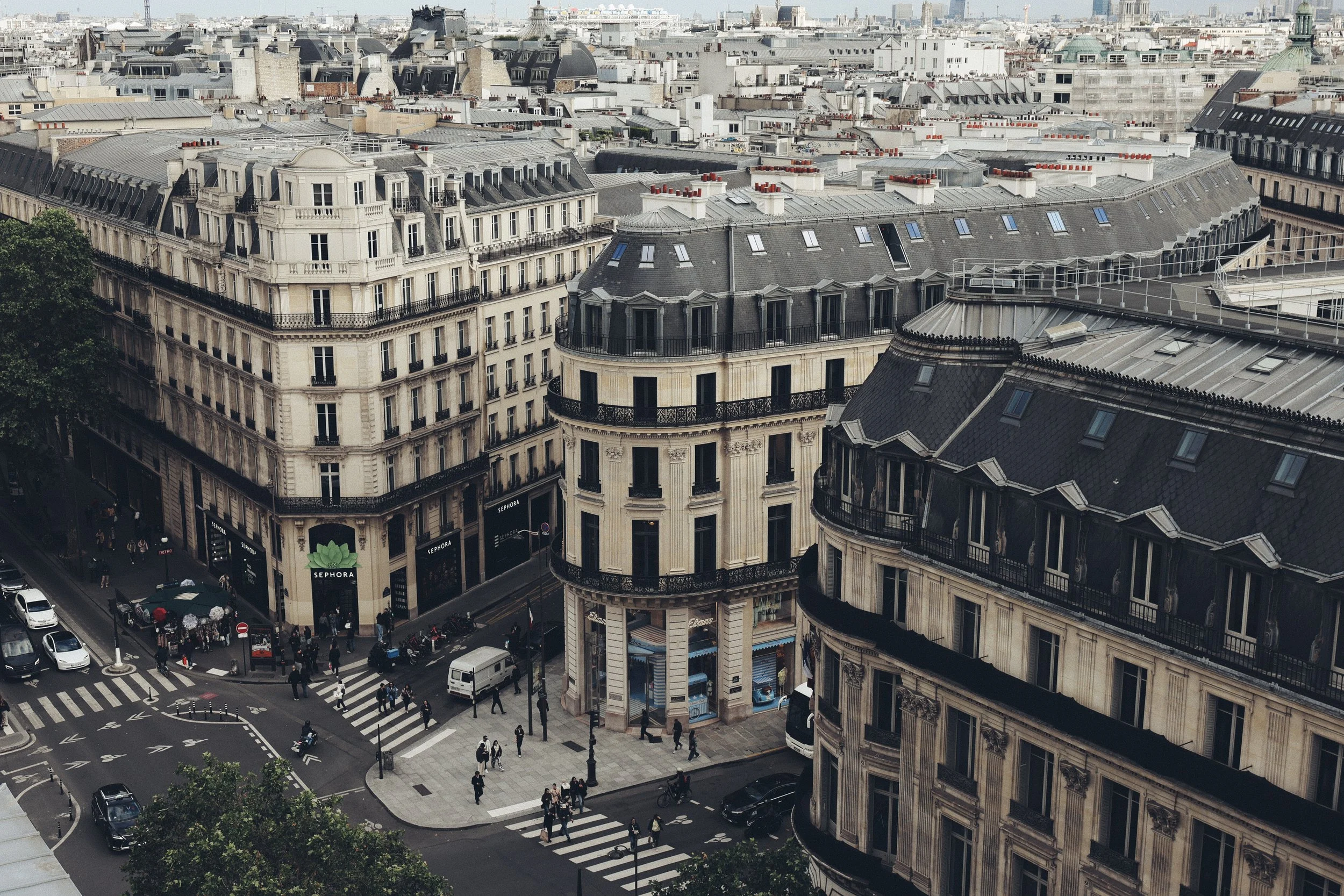
On approach: the Paris street photography community is consistent on one thing - natural beats posed. "Don't think Trocadéro and posing - think much less posing, much more natural photos" is the consistent advice from photographers who've worked the city seriously. Candid moments in cafés, metro stations, markets, and side streets tell more interesting stories than anyone standing in front of a landmark.
The Marais, Montmartre (specifically the back streets away from Sacré-Coeur), Quartier Latin, and Montorgueil are all neighborhoods that reward wandering without a specific shot in mind. Get comfortable with following your curiosity.
4. Composition: Thinking Like a Paris Photographer
Paris is an incredibly well-composed city in its own right - the Haussmann-era urban planning created natural leading lines, symmetrical facades, and layered perspectives everywhere. The challenge isn't finding good compositions; it's not leaning on the obvious ones.
Use architecture as framing. Arches, iron gates, doorways, bridges, and window frames all create natural foreground layers that add depth and context. Paris has more of these per square kilometer than almost any city on Earth.
Include people. A technically perfect shot of an empty Parisian street is fine; a technically imperfect shot of someone walking through a shaft of light tells a story. The city is most alive with human presence in the frame.
Look for reflections. Wet cobblestones after rain, café windows, the Seine, the puddles in Luxembourg Gardens - Paris reflects beautifully. Reflections double your composition options and add a quality that's hard to fake in post.
Embrace verticality. The typical 16:9 or 3:2 landscape crop is the obvious choice, but Paris's architecture - narrow streets, tall buildings, the vertical thrust of the Eiffel Tower - often rewards portrait orientation. Switch formats frequently.
Compression with a short telephoto. An 85mm or 135mm lens used from a distance compresses the layers of a Parisian street in a way that makes the city look like a stage set, in the best sense. The stacked cafés, signs, traffic, pedestrians, and distant monuments collapse into a rich, layered frame.
5. Gear and Camera Settings for Paris
You don't need expensive gear to take strong photos in Paris - the city will do most of the work. But a few practical notes:
Shoot RAW. The editing potential in a RAW file from a golden-hour Paris scene is significant, and the warm color palette of the city responds very well to the kind of tonal work that's only possible with uncompressed data. JPEG in Paris is leaving quality on the table.
Wide aperture for ambiance. Paris in low light - blue hour, café interiors, street lamps - rewards a fast lens. f/1.8 on a 35mm or 50mm is a classic Paris setup. The slight softness of out-of-focus background elements reinforces the dreamy quality the city naturally has.
A tripod (or stable surface) for blue hour. The best Paris shots at dusk require longer exposures to balance the ambient city light against the darkening sky. A compact travel tripod is genuinely worth carrying for evening work.
Travel light. Paris involves a lot of walking, stairs, and metro transfers. A single body with two lenses (a 24-35mm for environments and street, an 85mm for compression shots and portraits) is a more manageable kit than a full bag that you'll resent by 10am.
6. Editing Your Paris Photos
Shooting in Paris is only half the story. The city has a distinct color palette - warm limestone, blue-grey zinc rooftops, green ironwork, deep shadows - and editing choices that align with that palette tend to produce more cohesive results than applying generic filters.
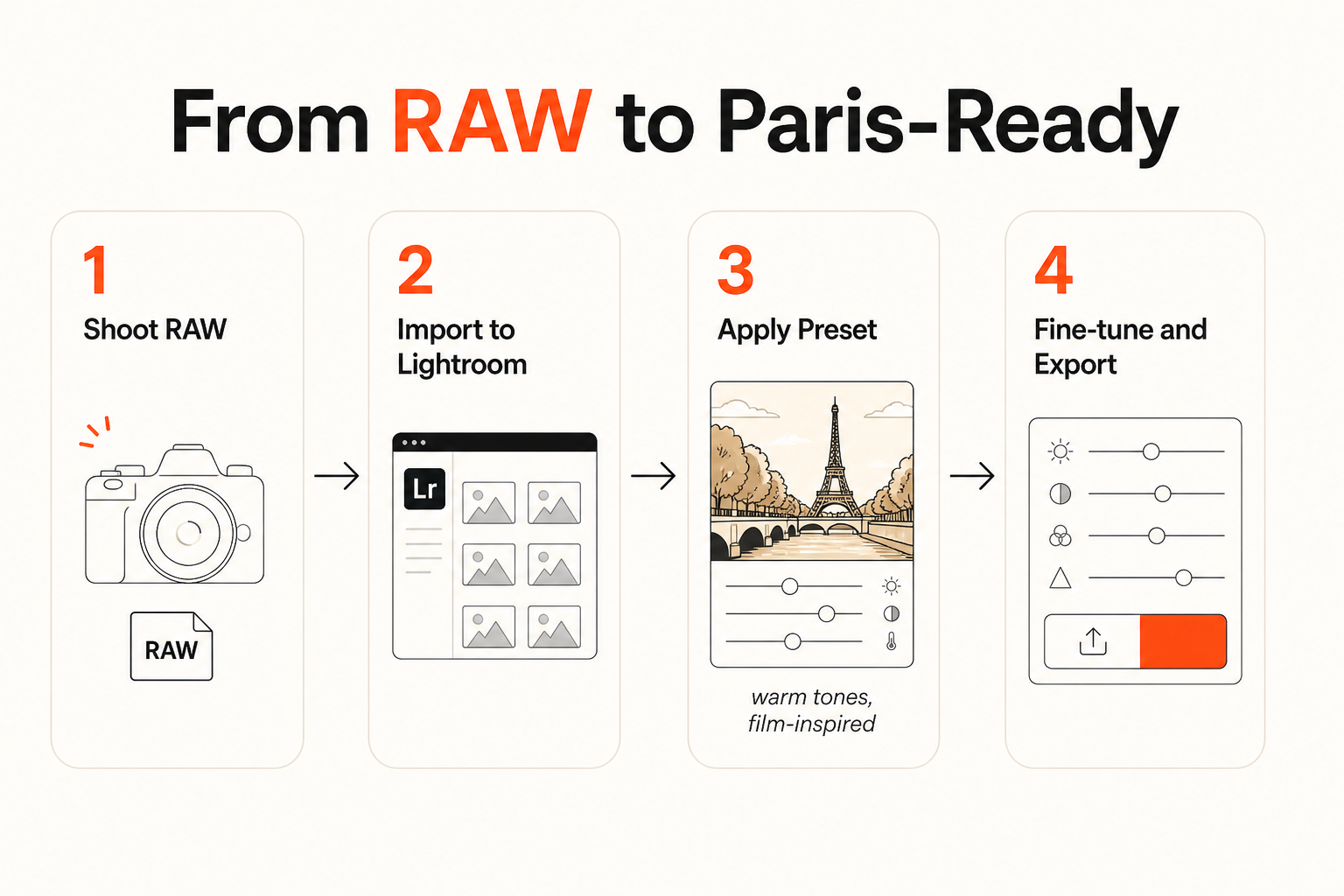
Warm the whites. Paris stone in golden hour light is not neutral white - it's amber. Editing that pushes the white balance toward warmth (4,800-5,500K range) reads as more natural and more cinematic than a neutral correction.
Matte the shadows. Lifting the black point slightly and compressing the overall contrast creates a film-like quality that suits Paris's romantic character. This is one of the signatures of analog and film-inspired editing styles.
Work the greens and blues carefully. Paris's specific green (the green of the Vélib' bikes, the métro signage, the zinc rooftops in certain light) is distinctive. Keeping those hues accurate rather than desaturating toward grey or pushing toward teal preserves the city's identity.
Consistency matters more than perfection. If you're posting a series of Paris images - for a blog, an Instagram carousel, a client gallery - visual consistency across the set reads as intentional and professional. Applying a single preset and then fine-tuning per image is faster and produces a more cohesive result than editing each image from scratch.
BeArt Presets for Paris Photography
The editing philosophy above - warm, film-inspired, matte shadows, rich tones - describes exactly the look that a well-designed Paris preset collection can deliver in a few clicks.
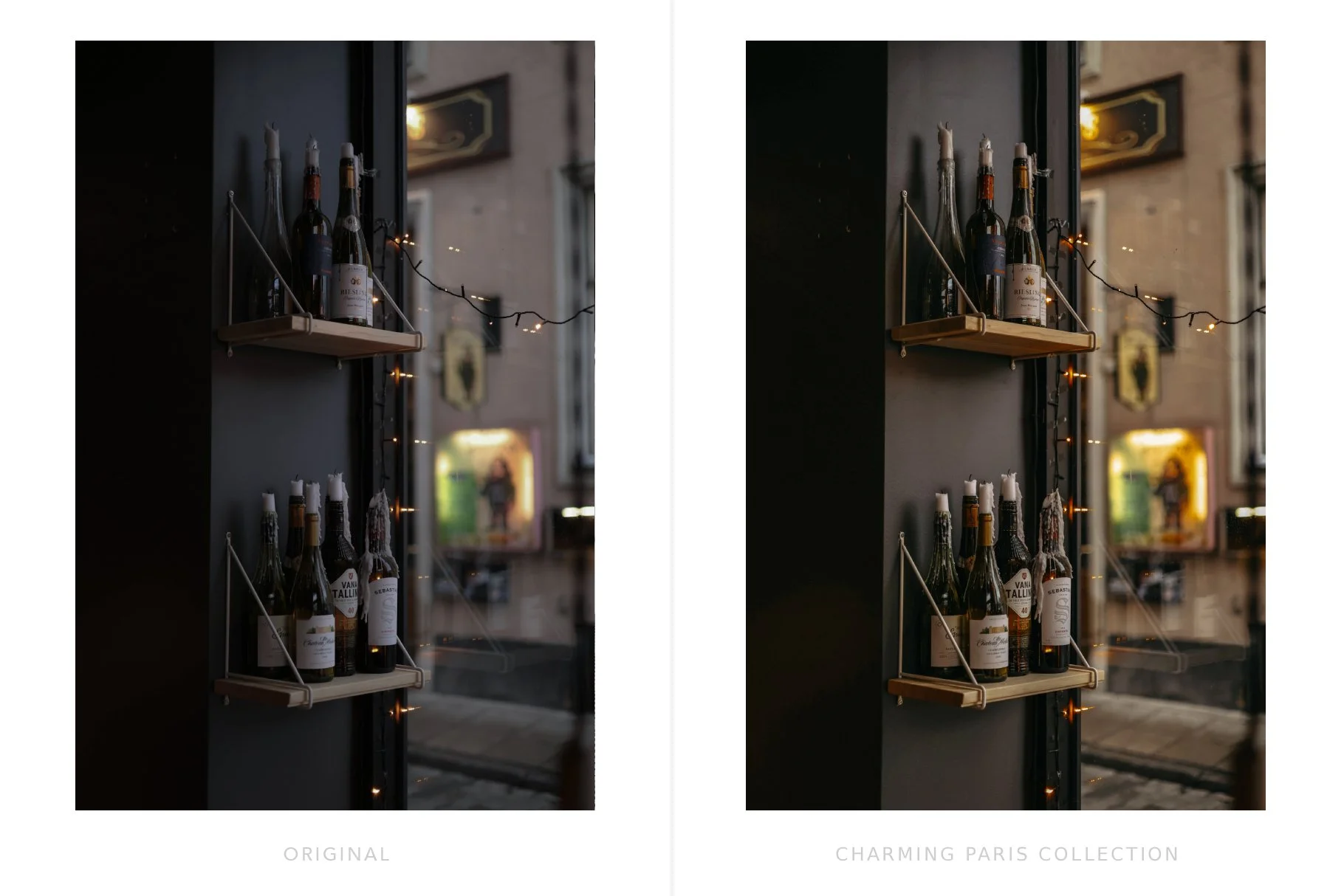
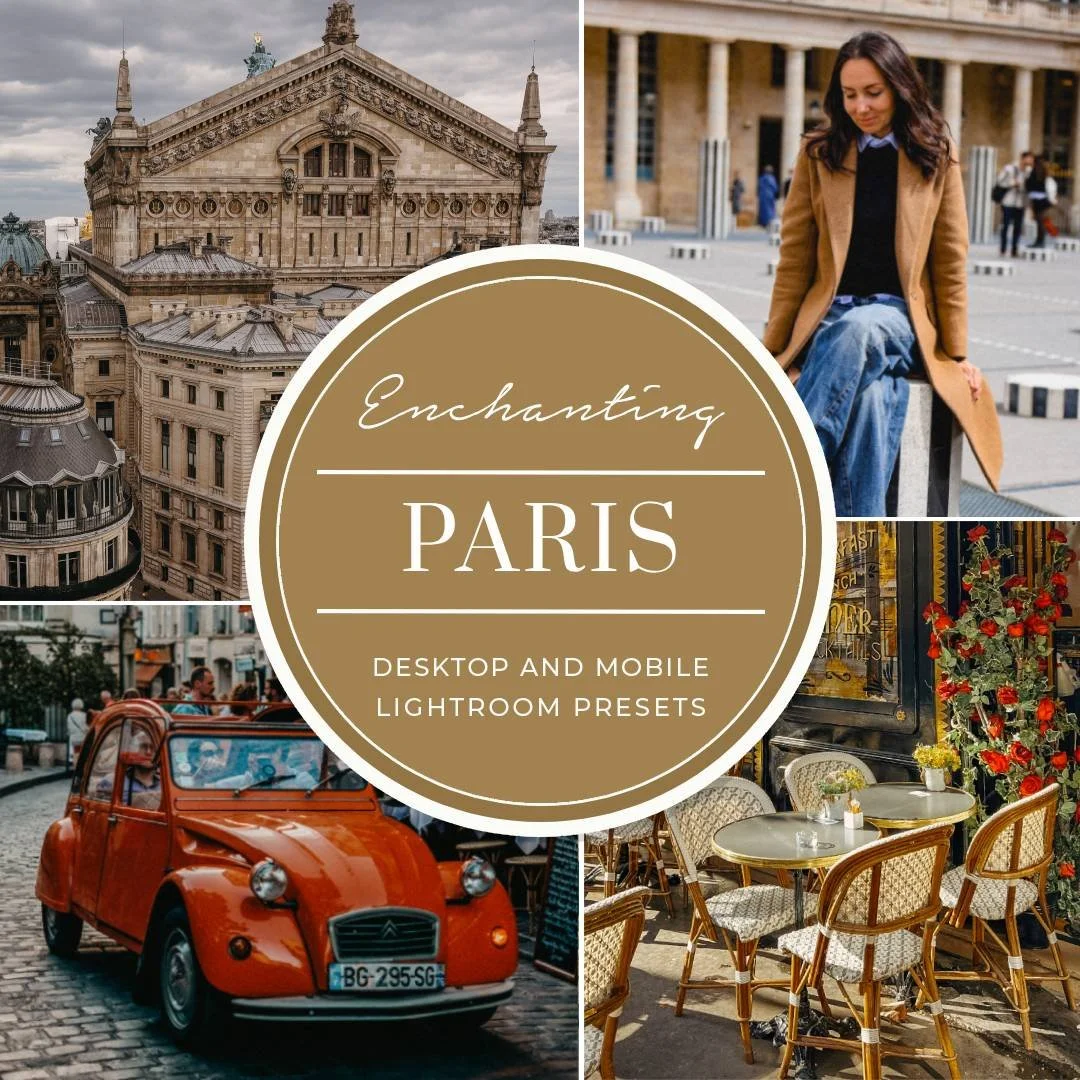
The Charming Paris Lightroom Presets collection includes 22 presets built specifically around the Paris color palette: warm neutrals, matte finishes, and film-inspired character that complement the city's light and architecture. They work across Lightroom Classic, Lightroom CC, Adobe Camera RAW, and Lightroom Mobile - so whether you edit on a desktop or your phone on the go, the look transfers. XMP and DNG formats are both included, at $19 for the full collection.
The Short Version
Paris will give you the images - if you show up at the right time, find the less-obvious angles, and edit with intention. Skip the midday crowds. Shoot at dawn or the blue hour after sunset. Wander into Butte aux Cailles and Menilmontant. Use the covered passages on grey days. And when you bring those images into Lightroom, lean into the warm, matte, film-inspired palette the city deserves.
Paris is endlessly photogenic, but the best Paris photos never happen by accident. They happen because someone planned their timing, did their homework on locations, and knew exactly how they wanted the final image to feel.




Get Free Presets for Lightroom created by top photographers to update your presets collection, save down on editing time, and open up new artistic horizons.
Introducing the Idyllic Santorini Lightroom Presets Collection, created for both mobile and desktop versions of Lightroom. Inspired by the timeless beauty of Santorini, this collection captures the feeling of returning home from an unforgettable journey with a camera full of memories. Whitewashed villages glowing in the afternoon sun, charming streets adorned with bougainvillea, leisurely breakfasts overlooking the sea, and soft pink sunsets melting into the horizon.
BUY NOW