Beyond the Portfolio: How Photographers Can Make Booking Feel Easier
Instagram is the most obvious place to look for a photographer. Built entirely around images, it’s the natural starting point for a visual search. But deciding to hire someone is no longer just a matter of finding a feed full of beautiful photos.
A client scrolling through an Instagram profile is looking for context. They want to see how you talk, how you direct people during a shoot, whether your work feels current, what past clients say about you, and what kind of person seems to be standing behind the camera.
That context matters because a photoshoot is a strangely personal service to book from a total stranger online. A client knows they are going to spend an hour or two with someone who will watch them closely, notice when they tense up, tell them where to put their hands, and eventually choose which versions of them make the final gallery. For anyone who already feels awkward in front of a camera, there is a massive amount of trust involved.
A polished portfolio can tell a potential client: “I like these photos.”The rest of your profile helps them answer something much more personal: “Can I imagine myself looking good in them, and would I actually feel comfortable being photographed by this person?”
You don’t have to understand photography to know what you want
Most clients aren’t evaluating photographers the way other photographers do. They probably have no idea what “editorial,” “direct flash,” or “film-inspired” means. They aren’t thinking about focal lengths, lighting setups, or color grading.
But they still have taste.
After years of consuming visual content on social media, people instinctively notice when posing feels dated, when skin has been retouched until it looks like plastic, or when every single client seems to have been forced into the exact same five poses and a copy-paste preset. They may not know the professional term for the style they prefer, but they immediately know whether they would be happy to see themselves in it.
That is why having depth in your portfolio highlights matters. One perfect image proves you took one perfect image. Twenty or thirty shoots give a much better sense of how you photograph different faces, bodies, locations, and clothes—and, crucially, how you photograph people who probably didn't arrive knowing what to do in front of a camera.
For the client, the first decision is simple: “I like how these people look. I want photos like this.”
Then comes the harder part.
“I’m not photogenic” usually means more than that
People say they aren’t photogenic all the time, but there are several different fears packed tightly into that one sentence.
Someone might hate the way they look when they know a lens is pointed at them. They might have no idea what to do with their hands or their face. They might worry that every pose will feel unnatural, or that everyone else somehow knows how to behave during a photoshoot and they simply missed the lesson.
There is also something deeply vulnerable about letting another person decide how you will be seen. During a session, the photographer notices details you normally don’t think about: your posture, your expressions, which side of your face you turn toward the camera, and the exact moment your shoulders stiffen. Then, you go home and anxiously wait to see what all of that looked like from the outside.
Professional Photographers of America’s 2026 consumer research found that friction often starts during the search itself. Prospective clients reported unclear pricing, too many options to compare, and—crucially—uncertainty about what to expect from the experience. They also tend to bounce between several places while deciding, checking websites, social media, and reviews.
That uncertainty is exactly what your Instagram presence can reduce before anyone ever sends a message. Saying that your sessions are “relaxed” in your bio is fine, but a nervous person gets far more reassurance from actually seeing what “relaxed” looks like.
Show the part that happens before the final photo
A polished portrait proves you can produce a polished portrait. A short behind-the-scenes Reel answers an entirely different question: “What happens to me before we get there?”
Let people hear the ordinary directions you give during a session: “Shift your weight back a little,” “Turn toward the light,” “Yep, stay right there.” Show somebody walking awkwardly into position, and then show the stunning finished frame. Explain what you do when a client starts out stiff, or why you sometimes give people a physical task to do instead of just asking them to stand still and “look natural.”
Outfit advice works the exact same way. Someone worried about choosing the wrong clothes doesn't necessarily need a 30-slide color-theory guide. Seeing two or three outfits that work beautifully for the type of session they want may be just enough to stop outfit anxiety from becoming a reason to postpone booking.
Behind-the-scenes content also reveals something a static portfolio never can: the photographer’s personality. One person might want an energetic photographer who talks constantly, makes jokes, and keeps the energy high. Another would hate that, feeling much better with someone quieter who gives simple directions and leaves a little space. Neither approach is objectively better—they are simply better fits for different people.
And fit matters here. You can hire plenty of professionals without caring whether you particularly like their personality. Spending an hour having someone study your face through a lens is a very different transaction.
Make it possible to imagine being one of your clients
An extremely polished portfolio can sometimes create distance instead of desire. If every single person in your feed looks like a professional model, and every image could have come from a high-end campaign, someone who already thinks they are awkward on camera might admire the work without ever thinking, “That could be me.”
So, show more than perfection. That doesn't mean publishing bad work. It means giving people enough context to understand that the relaxed, glowing person in the final photograph may have spent the first ten minutes warning you that they had no idea how to pose.
Client feedback is especially powerful when it touches on that exact part of the experience. “Love my photos!” is a nice review, but it tells the next client very little. “I thought I’d be awkward the whole time, but she kept giving me things to do and after ten minutes I stopped thinking about the camera” directly answers a fear that may have been holding someone back from booking for months.
The same goes for what actually appears in your feed. If you photograph a wide range of people, let that be visible. A potential client is often trying to answer a very basic, silent question: “Do people who look like me also look good in this photographer’s work?”
Popularity changes the impression before we know whether it should
There is another signal people pick up while scrolling, and it has almost nothing to do with composition or lighting.
Imagine finding two photographers whose work you like equally. One profile has a few hundred followers, barely any recent activity, and almost no interaction. The other has several thousand followers, recent shoots, active comments, client tags, and Stories from current work. You still have absolutely no way of knowing which photographer is technically better, kinder during a session, or more reliable about delivering the gallery.
But the second one instantly feels more established. You might subconsciously assume that getting a booking will be harder, or that their price will be higher.
Research outside the photography industry suggests that follower numbers really do affect these kinds of judgments. A 2025 study involving 460 participants found that products promoted by mega-influencers were perceived as more expensive than the exact same products promoted by micro-influencers. Perceived status and competence helped explain the effect.
That does not mean 15,000 followers automatically make someone a better photographer, and it certainly does not mean a follower count should ever replace looking at the actual work. But it does explain why visible popularity becomes a psychological shortcut when people are trying to assess a stranger online.
For photographers, that impression of popularity comes from more than just the number at the top of the profile. Recent work, client tags, comments, collaborations, Reels, and regular posting all prove that the business is active—and that other people are actively choosing to hire you.
Some photographers also rely on a targeted Instagram growth service for a small additional boost alongside what they are already doing organically. However, that works best purely as a supporting tool. Extra activity cannot make dated work feel current, clarify a confusing pricing structure, or convince someone they will feel comfortable during a session. The profile itself still has to do all the heavy lifting.
Make the path from “I like this” to “I’ll book” short
Someone can spend fifteen minutes looking through a photographer’s Instagram without liking a single post. They may still be doing quite a lot of research.
They want to know what you photograph, whether you will help with posing, what people normally wear, where your sessions happen, how far ahead they need to book, and exactly what they are supposed to do next. More personal anxieties are mixed in, too: Will this be awkward? Is this photographer going to make me feel stupid because I don’t know what to do? Do I seem like the kind of person they normally photograph?
You don’t need a separate Reel addressing every single anxiety. A few useful pinned posts and Highlights can answer most of them. Show how a session works, save outfit and location advice somewhere obvious, keep your best client feedback visible, and make the inquiry process incredibly easy to find.
The first DM you send should feel equally simple. Someone who has finally worked up the nerve to ask about a session probably does not need twelve different packages, six optional add-ons, and a dense questionnaire in the very first reply.
Find out what they want, give them the options that actually fit their request, explain what happens next—and reassure them that you will help with the posing.
Because by that point, the portfolio has already done its job. They like the photographs.
What the rest of your Instagram needs to do is make them believe they could be one of the people in them.




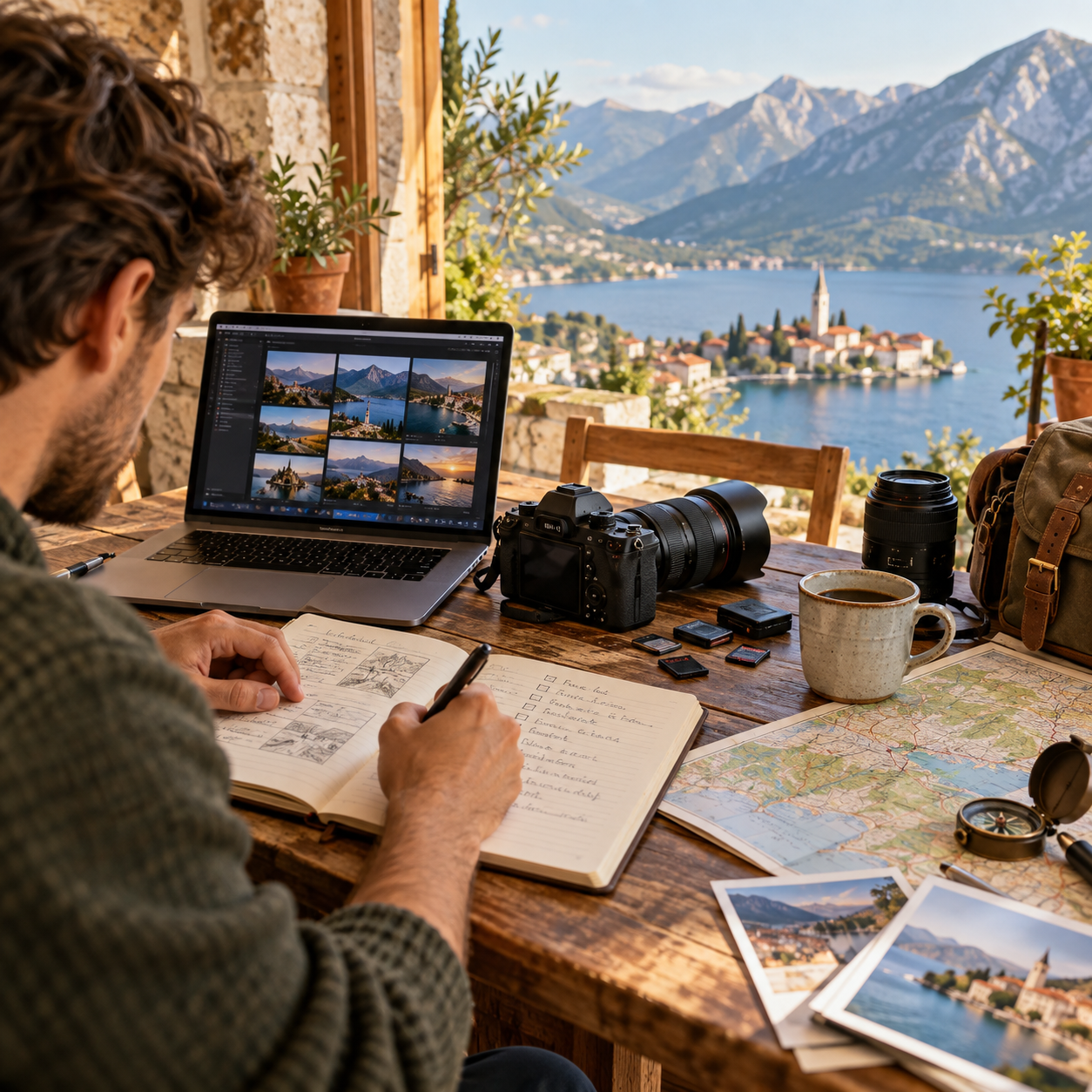

Get Free Presets for Lightroom created by top photographers to update your presets collection, save down on editing time, and open up new artistic horizons.
Introducing the Idyllic Santorini Lightroom Presets Collection, created for both mobile and desktop versions of Lightroom. Inspired by the timeless beauty of Santorini, this collection captures the feeling of returning home from an unforgettable journey with a camera full of memories. Whitewashed villages glowing in the afternoon sun, charming streets adorned with bougainvillea, leisurely breakfasts overlooking the sea, and soft pink sunsets melting into the horizon.
BUY NOW